


Summary
If you look at the map of Indonesia, you will find two islands with similar shapes but different sizes: Sulawesi and Halmahera. Sulawesi is the fourth largest island in Indonesia after Papua, while Halmahera is the eleventh largest island. Sulawesi has long been known as one of the islands most visited by birders, especially in the central and northern parts of Sulawesi. Meanwhile, Halmahera has become very popular because it is the habitat of the charismatic paradise bird, Wallace’s Standardwing BoP. The popularity of these two islands has been known for more than a century.
Currently, with better access, records of discoveries of endemic species on these two islands have increased significantly in the last decades. This encourages more and more birders to come and explore these two islands.
This time, I had the opportunity to go on a trip with two Bird and Wildlife Photographers, namely Naun Amable Silva from Peru and her friend Lindsey Lohan from America. According to the plan, this tour will last for 11 days from June 12 to June 22, 2023.
Details:
Naun and Lindsey had just ended their tour in West Papua the day before, on June 10, 2023. They flew from Sorong to Makasar, then arrived in Jakarta in the evening. Tomorrow we will fly from Jakarta to Manado. This flight was filled with the drama of changing flight schedules, which made me run around the airport in the middle of the night before morning with the end result being that we flew at 10 am from Jakarta to Manado.
Arriving in Manado, we stopped for food outside the airport before driving straight to Tomohon, then straight to Mount Mahawu to catch our first target. The rain had just stopped, and it was starting to get dark. We are looking for two targets here, namely Speckled Boobook and Sulawesi Scops-owl. Speckled Boobook only responds to calls without approaching. We finally got a good showing of the Sulawesi Scops Owl. That night we stayed at a hotel in Tomohon.
The next day we tried to target the Minahasa Masked Owl, but it didn’t respond to calls. Morning birding around Mahawu succeeded in finding several targets, including Sulawesi Pygmy Woodpecker, Citrine Canary Flycatcher, Sultan Cuckoo-dove, Sulawesi Babler, Grey-sided Flowerpecker, Crimson-crowned Flowerpecker. Our Mahawu trip ended at a Pitta hide where we had the opportunity to photograph Pitta and also a Scaly-breasted Kingfisher, just before the rain started to fall. Throughout the rest of the day, heavy rain fell throughout Tomohon. We spent more time hanging out. We encountered several species during rainy periods: Sulawesi Myzomela, Crimson Sunbird, Mountain Tailorbird, Black Sunbird, Barred Rail, Buff-banded Rail. Before dark, we drove to Batu Putih.
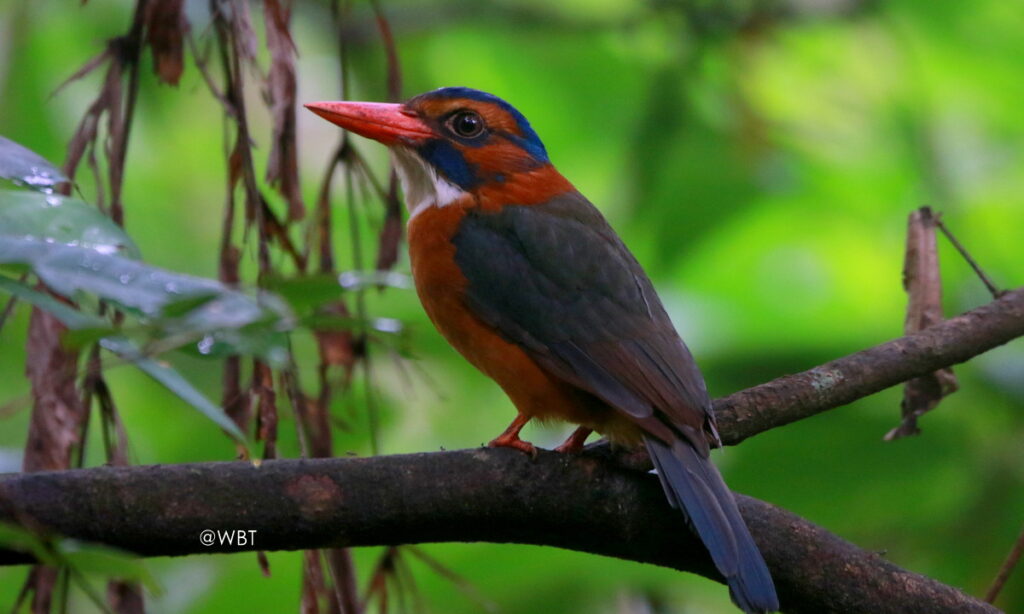
The first day in Tangkoko, we started birding at 05:30. Our main targets that day were five: Lilac-cheeked Kingfisher, Green-backed Kingfisher, Sulawesi Dwarf Kingfisher, Ashy Woodpecker, and Knobbed Hornbill. We managed to find all of them and photograph them. The bonus is, of course, that the main highlights of the Tangkoko forest are the Tarsier and Sulawesi Bear Cuscus. Another species we encountered was the Blue-cheeked Parrot.
The second day in Tangkoko, we did birding along the road between Batuputih and Temboan Hill. We achieved several important targets that day: Pygmy Hanging Parrot, Pale-blue Monarch, White-necked Myna, and Sulawesi Hanging-Parrot. In the afternoon, still on Temboan Hill, we managed to see and capture several target species, including White-faced Cuckoo-Dove, Sulawesi Hornbill, Purple-winged Roller, and Sulawesi Cicadabird.
On the third day, we went on a boat trip to the Sampirang river with the main target being the Great-billed Kingfisher. After searching for almost two hours, we finally found our target on the way back to the village. During our target search, we also met several interesting species including Grey-cheeked Green-Pigeon, Pied Imperial-Pigeon, Channel-billed Cuckoo, Glossy Swiftlet, Kentish Plover, Black-naped Tern, Great Crested Tern, Pacific Reef-Heron, Striated Heron, Brahminy Kite, White-bellied Sea-Eagle, Great-billed Kingfisher, Sacred Kingfisher, Collared Kingfisher, White-rumped Cuckooshrike, Slender-billed Crow, and Pacific Swallow.
In the afternoon, we drove to Manado. The last birding spot is Temboan Hill. That afternoon was quite productive because the weather conditions were quite sunny after the rain. Our important targets include Grey-cheeked Green-Pigeon, Glossy Swiftlet, Knobbed Hornbill, Sulawesi Hanging-Parrot, Pygmy Hanging-Parrot, Sulawesi Myna, Grey-sided Flowerpecker, Sahul Sunbird, Crimson Sunbird (Sulawesi), and White-faced Cuckoo-Dove.
From Manado, we flew in the morning to Ternate, North Maluku. The weather was cloudy throughout the flight. Luckily, when we arrived in Ternate, the weather was clear. From Ternate, we took a speedboat to Sidangoli. The weather was very hot in Sidangoli. After arriving, we had to rest at the inn all midday. In the afternoon, we headed to the first birding location, namely a logging track near the city. Here, we focused on photographing the Moluccan Flycatcher, Black Sunbird, and Violet-necked Lorikeet. Our final location was where we saw the Moluccan Scops Owl.
On the second day in Halmahera, we went to the Ivory-breasted Pitta location, which was not far from the Sidangoli – Akejawi causeway. It didn’t take long for us to wait for the target to come to the desired position. Once finished, we returned to Sidangoli to pack up. We then headed to East Halmahera, specifically to Subaim. Rain greeted us in Subaim. Despite the rain, we continued birding in the rice fields near the city and then headed to Uni-uni with the main target being the Moluccan Boobook. Unfortunately, the rain fell harder at night, making us unable to achieve our target.
The next day, early in the morning, we left the guesthouse for Uni – Uni, hoping that the weather would improve. It was still cloudy and sometimes drizzling. Despite the cloudy weather, we managed to achieve important targets including Paradise Crow and Blyth’s Hornbill. After lunch, we left Subaim for Akejawi. Here, we stayed at Mahroji’s house, one of the rangers of the Aketajawe – Lolobata National Park, located on the riverbank bordering the national park.
On June 20, we started the trip at 3 am by trekking 5km into the Aketajawe Lolobata National Park area. Our target for the day was the iconic bird of paradise, the Wallacea Standardwing Bird of Paradise. At this location, we made observations and photos of the hide built by the BBC team several months earlier. After leaving the Standardwing location, we headed to the North Moluccan Pitta location, where we managed to find three individuals in a location that had just been discovered. After lunch at Mahroji’s house, we continued our journey back to Sidangoli. From Sidangoli, we took a speedboat to Ternate and spent the night there.
The next day, we flew in under less-than-ideal weather conditions from Ternate to Makassar. Fortunately, the weather in Makassar was very good. We proceeded directly to Karaenta. The sun was high, offering only a glimmer of hope for reaching our target. After Karaenta, we ventured to Ramang – Ramang, birding in open rice fields throughout the afternoon. Exhausted, we returned early to the hotel.
Towards the end of the trip, in the morning, we visited the fish pond area west of Hasanudin Airport. Birding at this location took less than two hours. Several species of shorebirds and waterbirds were recorded here. We then returned to the hotel and made our way to Hasanudin Makassar Airport.